
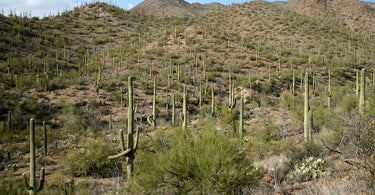
Picture a cactus that can grow 50 feet tall, weigh about 80 pounds for every foot of its trunk, and spend its first decade on Earth growing only a few inches. Now picture more than two million of them, arms raised like they are cheering you on. That is Saguaro National Park, and it might be the most cheerful landscape in the West.
The saguaro is the very symbol of the American Southwest, the cactus you have seen in a thousand cartoons and old Westerns. Seeing a real forest of them at sunset, glowing gold against purple mountains, is one of those travel moments that sticks with you. It is easily worth a spot on your national parks bucket list, and a happy little pin on your map.
Where is Saguaro National Park?
Saguaro is unusual because it comes in two pieces, with the city of Tucson, Arizona in between. The Rincon Mountain District, often called Saguaro East, sits on Tucson's east side, and its visitor center is at 3693 S. Old Spanish Trail. The Tucson Mountain District, or Saguaro West, sits on the west side, with the Red Hills Visitor Center at 2700 N. Kinney Road. The park warns that map apps often confuse the two districts, so type in the exact address of the side you want.
Together the two districts protect roughly 92,000 acres: about 67,000 acres in the east and about 25,000 acres in the west. President Herbert Hoover created Saguaro National Monument on March 1, 1933. President John F. Kennedy added the Tucson Mountain lands in 1961, and Saguaro became a national park in 1994.
Meet the giant of the Sonoran Desert
The saguaro grows only in the Sonoran Desert, and only where the balance of heat and rain is just right. Freezing temperatures can harm it, which is why saguaros generally grow below about 4,500 feet. Young saguaros start life in the shade of a "nurse tree" such as a palo verde, ironwood or mesquite, which shelters them from summer sun and winter frost.
Those accordion pleats are not just for looks. When it rains, a saguaro soaks up as much water as its roots allow, and the pleats expand to hold it. In dry times they contract again. The tallest one ever recorded reached 78 feet before it fell in 1986. Keep an eye out for crested saguaros, rare fan shaped growths; more than 50 have been found in the park.
From late April through June, creamy white flowers crown the tops of the trunks and arms. Each blossom opens at night and closes the next afternoon, and bats, birds and insects pollinate them. The saguaro blossom is Arizona's state flower. The cactus is also an apartment building for wildlife. Gila woodpeckers and gilded flickers carve nest holes into the trunk, and when they move out, elf owls, screech owls, purple martins and finches may move in.

Eight thousand years of desert living
The park's archeological sites span more than 8,000 years of human history. Most of the rock art here dates to the Hohokam, farmers, gatherers and hunters who lived in the river valleys and deserts of southern Arizona for centuries. Signal Hill in the Tucson Mountain District is one of the park's rock art sites, and Hohokam designs often include spirals and stylized people, bighorn sheep and deer. Please look but never touch, since the oils on your skin can damage them.
The saguaro has long been central to the O'odham peoples, who ate its sweet fruit, made it into a syrupy ceremonial wine and ground its protein rich seeds. Saguaro ribs became the framework for homes and the long poles used to knock ripe fruit from the tops of the cactus. Today the Tohono O'odham Nation and the park work together to support the traditional harvest of saguaro fruit and cholla buds.
Best things to do at Saguaro National Park
Drive the Cactus Forest Loop
In the Rincon Mountain District, the paved Cactus Forest Loop Drive winds for eight miles past trailheads, pullouts and some of the oldest saguaro forest in the park. The park suggests the loop as one of the best places in the east district to watch the sunset. There is no RV parking along the drive.
Explore the Bajada Loop Drive
On the west side, the Scenic Bajada Loop Drive is an unpaved, graded dirt road with picnic areas, viewpoints and trailheads. You do not need high clearance or four wheel drive. The west district has a higher density of saguaros than the east, so the views are thick with cactus arms.
Hike to a homestead or a mine
For an easy outing in the east, the Freeman Homestead Trail is about one mile and leads to an old homestead foundation and a grove of large saguaros. In the west, the King Canyon and Gould Mine Loop is about 2.4 miles with roughly 380 feet of elevation gain.
Climb toward Wasson Peak
At 4,687 feet, Wasson Peak is the highest point in the west district. The Sendero Esperanza Trail climbs to the ridgeline, and you can continue on the Hugh Norris Trail to the summit for panoramic views. Depending on how far you go, the round trip runs from 3.4 to 8 miles.
Join a ranger or head into the wilderness
Many ranger led programs are offered in winter, from garden talks to night hikes. Experienced backpackers can climb from about 3,000 feet to over 8,000 feet in roughly 15 miles in the Rincon Mountains, where six designated backcountry campgrounds require reservations.

Tips for planning your visit
- Best time to go: Winter is delightful, with days averaging around 65°F and cool nights. Summers regularly top 100°F, so hike early. The monsoon season, June 15 to September 30, brings dramatic afternoon storms.
- Fees and reservations: Check the official NPS website for current fees and any reservation requirements before you go.
- Pick your district: If you only have a few hours, choose one side. The east offers the paved loop and higher mountains, while the west offers denser saguaros and petroglyphs.
- Vehicle limits: Gates Pass, the shortcut from central Tucson to the west district, has a 12,000 pound weight limit and is not recommended for vehicles over 25 feet.
- Look, do not touch: Cactus spines are not poisonous, but puncture wounds can become infected. Closed toe shoes are a smart idea.
- Road trip pairing: Head east on Interstate 10 to Willcox, then south on Highway 186 to Chiricahua National Park for a classic Southern Arizona road trip.
🐝 A note from PennyBee
We like to think every saguaro is giving you a big wave, or maybe a double thumbs up for finally making the trip. A cactus with that much enthusiasm deserves a pin on your map. Just be glad your push pins are made of wood and not spines.
Add Saguaro to your national parks map
Once you have watched the sun set behind those famous arms, bring the memory home. Our US National Parks Push Pin Map shows all 64 national parks and comes with a handmade wooden tree pin for each one, ready to mark Saguaro and every park still on your list.

Keep planning with our guide on how to track the national parks you visit and our full collection of national and state park maps. Turning this into a Southern Arizona road trip? Read our story on Chiricahua, America's newest national park, a wonderland of rock spires farther east.
Featured image: Photo: Todd M. Edgar, NPS, public domain, via Wikimedia Commons.

